


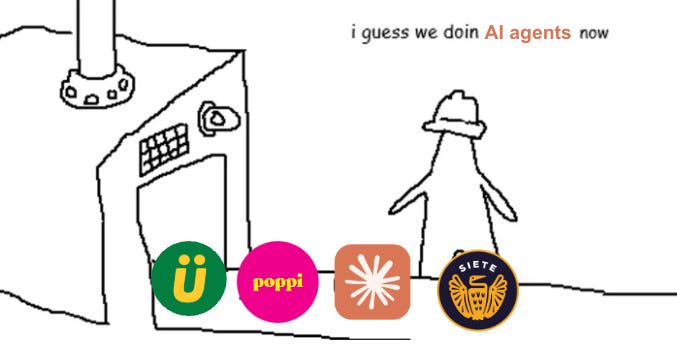
Launching a CPG brand historically followed a playbook.
A founder identifies a market gap. A product lead formulates a product. A brand marketer designs creative. A supply chain exec leads manufacturing. And a performance marketer sells the product. (At the early stage, each person often wears multiple hats).
I call this the traditional playbook. It produced Grüns, Poppi and every successful VC-backed CPG brand to date.
But AI agents are enabling a new playbook.
A technical founder builds an AI agent that identifies a market gap, another agent that designs the branding, and another that runs paid ads, etc. The founder stitches those workflows together, and the agents launch a CPG brand, or many brands.
I call this the AI Brand Factory playbook.
The benefit of the AI Brand Factory is you can launch many CPG brands at once – and get more shots on goal at a big exit. But for this model to work, you have to believe that AI agents can effectively replace human functions.
A few weeks ago, a company called Taurus announced they’re doing exactly this.
They want to be “the AI-native Procter & Gamble — powered by agents, not org charts.” They’ve built a stack of AI agents that handles a CPG brand’s full lifecycle: product ideation, positioning, creative generation, customer support, supply chain coordination, vendor negotiations. I imagine some human in the loop is needed at most steps. But I’m not surprised that these functions can be supercharged, if not replaced, by agents.
Taurus already has two brands live. Aniwell is a pet supplements brand. Faunt is a women’s personal care brand. Taurus says their agents can get a new brand from initial concept to market in just 6-8 weeks – down from several months.
Another startup, Starday, says their goal is to “launch 100 brands over the next decade that would produce a billion in annual EBITDA.” They’ve already produced one cracker brand, Habeya, that I recognize from the supermarket.
It’s an interesting approach to building a VC-backed CPG brand. Instead of raising funds to build one consumer brand, you raise funds to build AI workflows – which then build multiple brands.
When I think about why this AI Brand Factory model makes sense for CPG, I think of three criteria needed to make things work for an industry.
Criteria #1: AI agents can replicate human functions. Building a CPG product is a repeatable playbook, and the major functions – creative, paid ads, customer support, etc – are well understood, so AI agents can be built to mimic them. Of course humans in the loop still matter. For example the CEO should go meet their manufacturer in person. But AI agents can replicate, or at the minimum supercharge, the specific functions of many CPG employees. However, you have to believe that the outcome won’t be generic AI Slop brands; those won’t appeal to consumers.
Criteria #2: You can fail cheaply and quickly. The beauty of CPG is you can test product-market fit for a CPG brand cheaply and incrementally. You can launch a DTC product with a small manufacturing run and a modest ad budget, and within days you’ll know whether people are clicking. Within weeks you’ll know whether they’re re-ordering. So you can theoretically test 10 different brands and quickly identify what’s working.
Criteria #3: You can double down on the winners. The flip side of failing cheaply and quickly is you can double down on what’s working. Whereas most brands flop, the few winners can compound into household names. Once a brand hits, you can pour fuel on the fire – more ad spend, more SKUs, more retail channels, etc. In fact, if a brand built by agents caught fire, you could even hire top-tier human executives to run the brand, and the agents would have served as incubation tools. An AI Brand Factory’s math likely works under the power law like VC firms, where one brand drives the bulk of value.
Put these three criteria together, and you start to see why this thesis is unique to consumer companies. B2B companies have less templatable human functions, longer sales cycles, and products co-designed with specific customers.
But I do think many consumer sectors check the three criteria for the AI Brand Factory model.
Mobile Gaming: AI agents can replicate many functions within mobile game studios, like creative ideation, art direction, and QA. A studio can leverage agents to ship many titles quickly and cheaply, and double down on the winners. Mission Control and Series are two examples of studios doing this.
Fashion: Fashion also has many replicable functions — clothing design, marketing assets, paid social. You could theoretically spin up a portfolio of TikTok Shop brands, launch them all at once and invest in the winners. For example, Finesse is using social media listening to figure out what consumers want and designing products around those signals.
Media: Media might be the simplest example. All you need to build original IP is an LLM to generate a script and a video model to generate content. On TikTok, some accounts are generating entire IP universes – like Fruit Love Island, which has 2.6 million followers. I’m excited to see if anyone can translate AI-generated IP like Italian Brainrot from TikTok to a meaningful studio deal.
I think we’ll soon see AI Brand Factories pop up across these verticals. The founders will just look very different from those native to each sector. They’ll be highly technical. They’ll hire engineers to build agents rather than individuals for specific functions. And they’ll look to spin up not one but many brands at the same time.
If you’re building an AI Brand Factory – in CPG, gaming, fashion, media or any other consumer sector – please reach out. I’d love to meet you.