


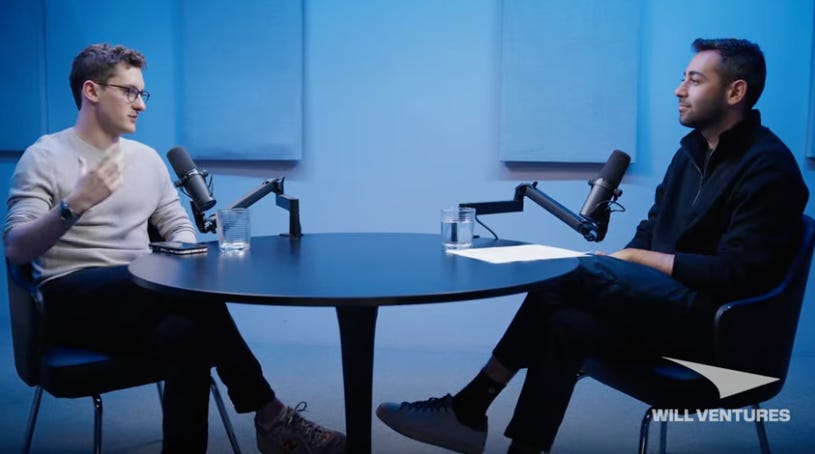
Jacob Fortinsky and I go way back.
We went to the same high school, played on the basketball team, and started a political debate club – where we probably screamed at each other about issues we knew little about.
15 years later, we can finally say we know about one thing: the sports industry. And specifically sports betting.
I spend a lot of my time at Will Ventures covering everything real-money gaming, and Jacob leads one of the most interesting companies in the space.
So we had to run back our debate days and record a podcast.
Jacob’s the founder & CEO of Novig, which wants to become America’s #1 sports prediction market. They recently raised $75 million at a $500 million valuation. And looking across the prediction market landscape, I think they have an interesting lane to become the go-to prediction market for sports fans.
Kalshi and Polymarket, the two best-funded prediction market startups, will eventually have to pivot their brand and product away from sports, if they’re going to achieve their $100B+ visions of building a new asset class around event contracts.
DraftKings, FanDuel and other sports betting incumbents are hesitant to cannibalize their state-licensed sportsbook businesses, and they’re also slow-moving conglomerates.
Meanwhile, Novig is part of a crop of growth-stage companies that 1) move with the speed of a startup and 2) already understand the sports betting customer. Novig’s bet is those two things will help them ship the best product and build the best brand in the space.
In this episode, we talked about Jacob’s story founding Novig, his long-term ambitions for the company, and much more. But I’ll highlight three of my favorite parts here.
On Nate Silver’s Book & The Expected Value Mindset
We started by talking about Nate Silver’s most recent book “On the Edge.” I couldn’t recommend it enough.
The book’s thesis: there’s a class of risk-takers shaping 21st century society, and these people share the same “expected value mindset.” They’re always asking what decision produces the most EV in the long-run. This mindset translates across pro poker players, hedge fund traders, and tech founders – especially in sports betting.
Jacob fits that mold. In college, he played in high-level poker games with Harvard students. And at the end of college, he founded Novig because he thought about the highest expected value for his career, and realized it was to start a company.
“When I started the company, I was surrounded by friends who said ‘oh I want to start a company eventually, but I’m gonna first work at Goldman, I’m gonna work at McKinsey.’ I remember thinking to myself, that’s idiotic. Your opportunity cost is only going to rise. Sure, you’ll maybe have some money saved in the bank, but now is actually the time to take this risk. You need to have nothing to lose to really succeed.”
That risk-on mentality really isn’t common among high-achieving, credentialed young people. But Jacob has that EV mindset, and that helped him make the leap to start Novig in his Harvard dorm room.
On not being “The House”
In the last few months, basically every prediction market has made the marketing pitch of “we’re not the house.” The idea is that sportsbooks bake in a margin (the “vig”) into every line and make money when you lose. Meanwhile, peer-to-peer exchanges don’t take a vig (hence Novig). Two traders on each side price the market, and the exchange takes a transaction fee.
But I pushed back on the fairness of the “we’re not the house” pitch. In the peer-to-peer model, bettors aren’t losing money to DraftKings. But they’re losing money to sophisticated market makers like Susquehanna who have real-time data, pricing models and other infrastructure that retail bettors can’t match.
Jacob drew an interesting parallel that I hadn’t heard before:
“We’re doing to sports trading what eBay did to e-commerce, what Uber did to ride share, what Airbnb did to hospitality – basically saying instead of having to bet against the house, who’s pricing every market and adding hidden fees (what’s known as the vig, hence our name, no vig), we’re allowing anyone to be their own house, to offer their own odds on the other side of the market.”
He went on to explain that as any business turns from a house-owned model to a marketplace, the take rate compresses, and the economic surplus to the user increases. As more activity shifts from sportsbooks to prediction markets, I’m curious to see how the spreads compare.
One thing I’ll agree with is a huge benefit of the exchange model is they don’t ban winners like the sportsbooks do. As Jacob said “today sports betting is the only industry that bans its power users.”
On responsible gaming policy
Towards the end of the episode, we talked about two touchy issues: gambling addiction and the convergence of fintech and gambling products. I wrote about this a couple weeks ago: “America Needs Better Gambling Policy.”
During March Madness I got push notifications from Robinhood and Coinbase encouraging me to bet on the tournament. These are the same companies pitching themselves as financial management tools, and that really bothered me.
Jacob agreed:
“If you’ve onboarded users telling them this is where you protect your life savings, you probably should not be pushing notifications to trade Jackson State to upset UConn. It’s not just inconsistent – it’s dangerous to have those two buttons next to each other.”
He thinks there should be a separation between church and state: keep speculative products and long-term financial products in different apps, with different brands and different UX. If you download Novig, he wants you to know exactly what you’re getting. I’m glad that Novig’s taking responsible gaming seriously.
##
Check out the full podcast above!
Reading executive interviews, exploring sports betting exchange innovations, and following prediction market discussions is always so insightful for industry observers. I actually stumbled across [kingjohnnie](https://johnnieking.org) while browsing through various business Substacks and looking for quick digital entertainment options during a market-research break. Thanks for sharing such a detailed and forward-looking conversation!
Great listen